Agentic Triage
AI-native triage workflows inside DICOM Vision®
Agentic Triage helps inspect DICOM studies, identify relevant series, analyze multiple views, generate structured observations and support prioritization for human review.
The problem
Real clinical imaging workflows are more complex than uploading one image and receiving one prediction.
A DICOM study may contain multiple series, different views, variable acquisition quality, artifacts, missing context and prior exams. Some findings only become meaningful when evidence is reviewed across the full study.
Traditional AI tools often sit outside the clinical workflow, requiring separate exports, separate interfaces or isolated model outputs.
Agentic Triage is designed to reduce this friction by bringing contextual AI analysis directly into the medical imaging workflow.
What Agentic Triage does
Agentic Triage helps imaging teams:
- inspect DICOM studies
- identify relevant series and views
- analyze multiple images in context
- surface potentially relevant patterns
- reason about uncertainty
- compare with prior exams when available
- generate structured observations
- signal review priority for qualified human evaluation
- support review prioritization
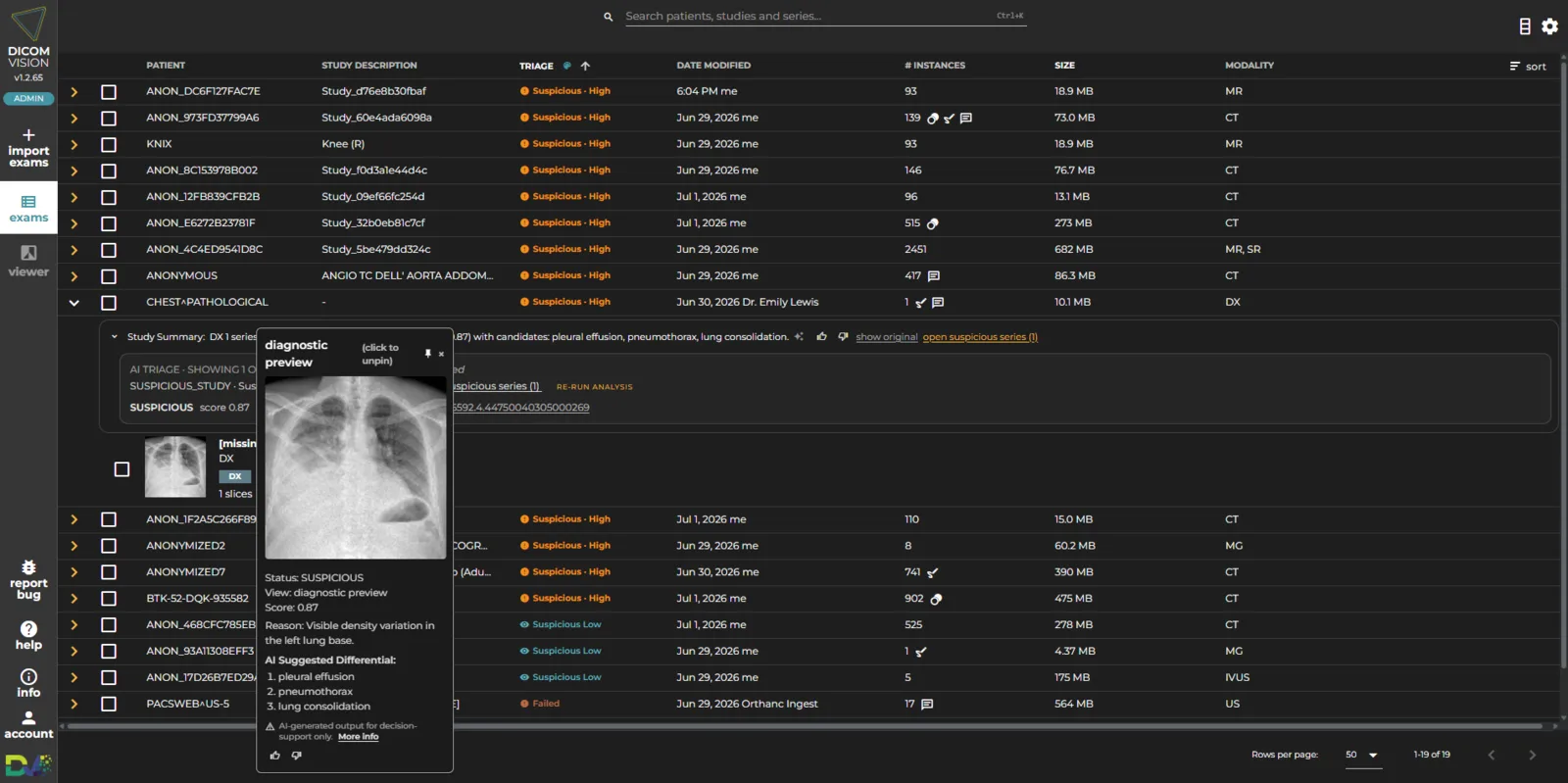
Agentic Triage inside the study workflow
The triage signal appears directly in the study workflow, helping users review study context, priority and AI-assisted observations without leaving DICOM Vision®.
Available now
The first Agentic Triage capabilities are already available in DICOM Vision® self-service plans.
Current workflows support AI-assisted image analysis, structured observations and possible differential considerations for qualified human review.
How Agentic Triage works
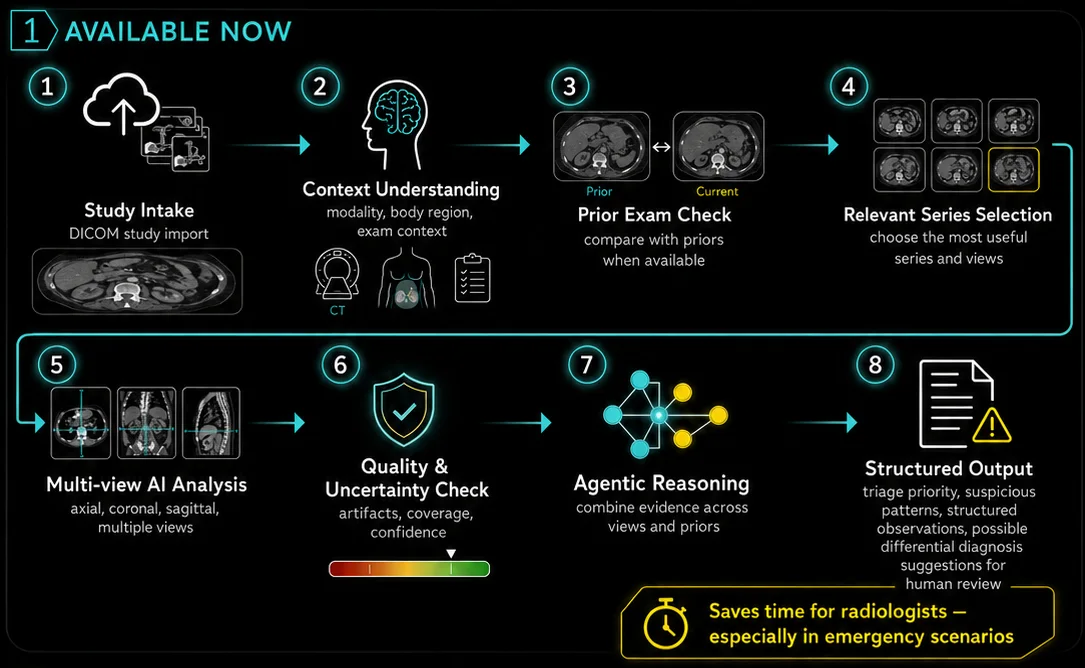
Agentic Triage is designed to support the imaging workflow from study intake to human review.
Study intake The DICOM study is imported into DICOM Vision® from upload, PACS integration or the configured imaging workflow.
Context understanding The system reviews available context such as modality, body region, study description, series structure, metadata and available prior exams.
Relevant series selection Agentic Triage identifies the most useful series and views for AI-assisted analysis, reducing the need to manually inspect every sequence before review.
Multi-view analysis The selected images are analyzed across multiple views, helping surface potentially relevant patterns that may not be clear from a single image alone.
Quality and uncertainty check The workflow considers image quality, artifacts, coverage and uncertainty, so outputs can be reviewed with appropriate caution.
Structured output The system organizes the results into structured observations, including review priority, relevant image context, uncertainty notes and possible differential considerations.
Review-ready output Structured observations are translated into a clear, human-readable summary that can be reviewed directly inside DICOM Vision®. The output is designed to help users understand why a case was prioritized, which evidence was considered and which areas may require closer attention.
Human review AI-generated outputs remain inside DICOM Vision® and are intended to support, not replace, clinical interpretation by qualified healthcare professionals.
Why it matters
In emergency and high-pressure scenarios, imaging teams need to focus attention quickly.
Agentic Triage does not replace radiologists or qualified healthcare professionals. It is designed to reduce time spent navigating complex studies before review, surface potentially relevant information and support a more structured reading workflow.
More than a model attached to a viewer
Agentic Triage is not designed as a standalone AI model placed next to a DICOM viewer.
It is designed as workflow-native imaging infrastructure.
Inside DICOM Vision®, AI analysis can be connected with DICOM/PACS pipelines, collaborative review, study sharing, annotations, segmentation workflows, prior exam analysis and custom AI models.
This makes AI easier to access, review, explain and integrate into real clinical and research workflows.
Next evolution
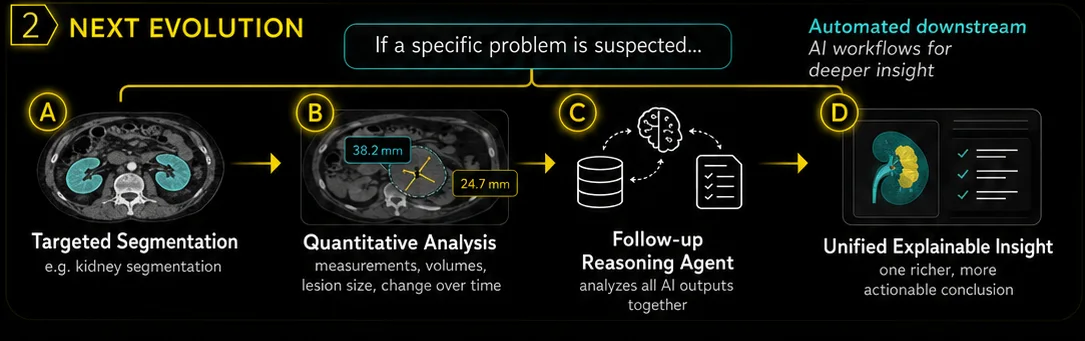
The next evolution is targeted AI orchestration.
When Agentic Triage identifies a potentially relevant finding, it can trigger dedicated downstream workflows.
For example, a potentially relevant renal finding could trigger a kidney-focused segmentation workflow, extract quantitative measurements, estimate volumes and pass the results to another reasoning layer.
Built for advanced integrations
Agentic Triage is designed to support advanced imaging workflows, including:
DICOM/PACS integration
Connect triage logic with imaging pipelines and deployment-specific infrastructure.
Cloud and on-premise
Support self-service, institutional and controlled deployment contexts.
Segmentation pipelines
Trigger downstream segmentation and quantitative imaging workflows.
Custom AI models
Integrate partner, research or deployment-specific models into DICOM Vision®.
Who it is for
Agentic Triage is designed for radiologists, imaging centers, hospitals, research teams and AI partners exploring advanced medical imaging workflows.
It can support self-service use cases, internal research projects, clinical workflow pilots and custom AI integrations inside the DICOM Vision® platform.
Explore Agentic Triage with DICOM Vision®
DICOM Vision® is becoming an AI-native medical imaging platform where visualization, collaboration, segmentation, prior exam review and AI-assisted analysis work together inside a single workflow.
Agentic Triage is intended to support qualified healthcare professionals and does not replace clinical judgment. AI-generated outputs must be reviewed and interpreted by qualified users. Availability of specific capabilities may depend on plan, deployment context, validation status and regulatory requirements.